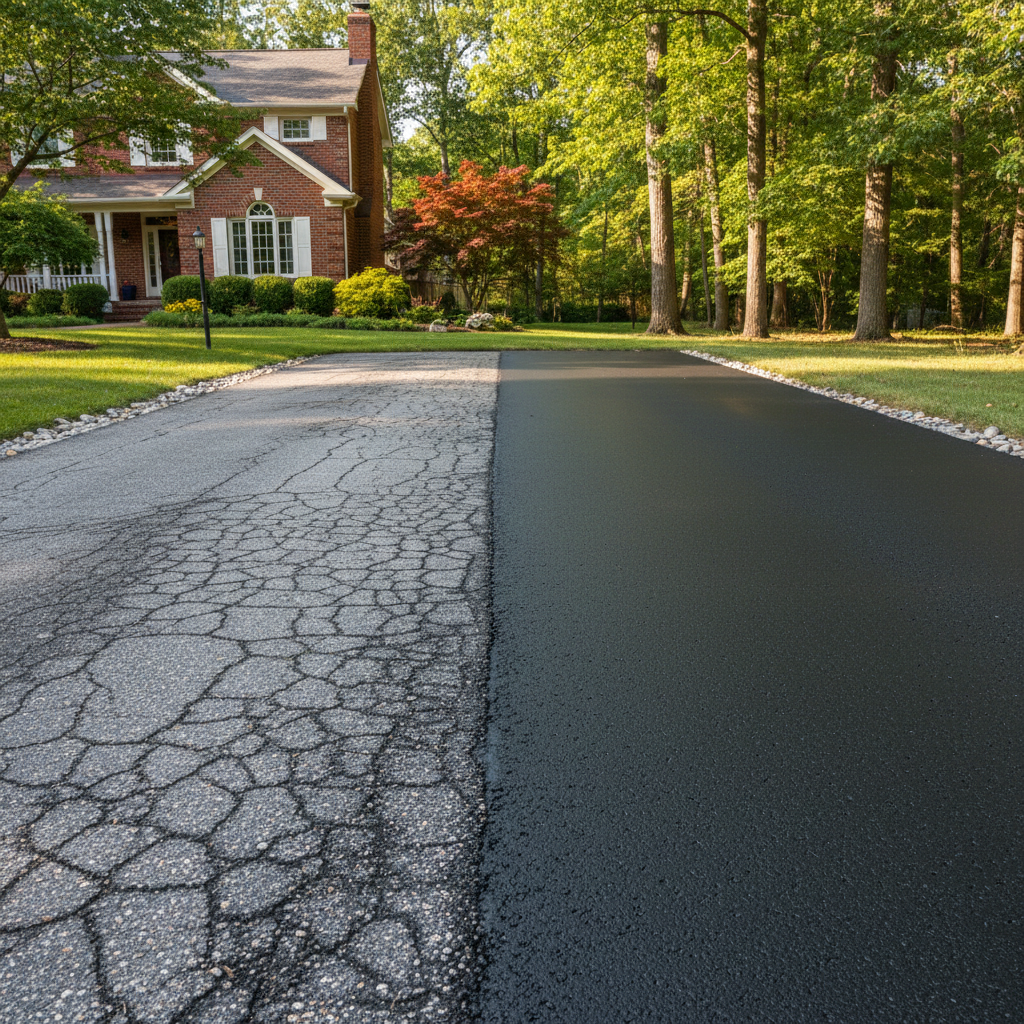
Alright, let's talk driveways for a minute. If you're a homeowner right here in Fort Smith, you've probably glanced at your asphalt lately and thought, "Man, this thing has definitely seen better days." Maybe you're spotting some cracks starting to creep in, or it just looks faded and worn out. When that happens, you've really got two main paths forward: an asphalt overlay or a full-depth replacement. I've personally checked out a ton of driveways across neighborhoods, from Chaffee Crossing all the way to Fianna Hills, and I can tell you, picking the right one makes a huge difference — especially with our unpredictable Arkansas weather, wouldn't you agree?
Asphalt Overlay: The Quick Refresh
Think of an asphalt overlay as giving your driveway a fresh coat of paint, but it's much thicker and way more durable. Essentially, we're laying a brand-new layer of asphalt right over your existing one. Before we even get to that, though, we'll clean up the old surface, fix any big cracks, and mill down edges where necessary so the new layer blends in smoothly. Typically, this fresh layer is about 1.5 to 2 inches thick.
Cost
This is usually the biggest selling point for homeowners. An overlay generally costs 30% to 50% less than doing a full replacement. You're probably looking at roughly $3 to $7 per square foot for an overlay. Why the savings? Well, we're not tearing out the old stuff, which cuts down a lot on labor and disposal fees.
Durability
An overlay can stretch your driveway's life by another 8 to 15 years, sometimes even 20 years for residential driveways that don't see heavy traffic — but only if the base underneath is still solid. That "solid base" part is key here. If your current driveway has deep, widespread cracks (we call that 'alligator cracking') or soft spots, an overlay simply won't fix those underlying structural issues. Those problems will just show through the new surface pretty quickly, usually within a year or two.
Maintenance
Just like any asphalt, an overlay needs a little TLC. Regular crack sealing is super important to stop water from seeping into the base, especially with our freeze-thaw cycles here in Fort Smith. You'll also want to sealcoat it every 3-5 years. That protects it from UV rays and oxidation, which can really bake asphalt during our hot summers.
Appearance
A fresh overlay looks fantastic. It's smooth, dark, and really boosts your home's curb appeal. To most people, it'll look just like a brand-new driveway. All those minor imperfections, fading, and surface cracks that were bothering you? Gone.
Full-Depth Asphalt Replacement: The Fresh Start
Okay, this is the big one. A full-depth replacement means we're pulling out your entire existing driveway, right down to the sub-base, and rebuilding it from scratch. This involves digging it out, grading the area, laying down a stable aggregate base, and then applying and compacting new hot asphalt.
Cost
As you might guess, this is the more expensive option up front. You're looking at $7 to $13 per square foot for a brand-new asphalt driveway, or $8 to $15 per square foot if we're replacing an old one — that extra cost is for the demolition and removal. It's a bigger investment because it's a much more intensive job, needing more materials and labor.
Durability
This is where full replacement really shines. When it's done right, a new asphalt driveway can last 15 to 20 years, and often even 20 to 30 years if you keep up with the maintenance. Since we're rebuilding the entire structure, including the base, it's built to handle heavy use and stand up to the elements for a much longer time. This is especially crucial in Fort Smith, where our clay-heavy soils can shift with wet winters and dry summers, causing real problems if the base isn't prepared correctly.
Maintenance
While the initial cost is higher, a full replacement generally needs less intensive maintenance over its lifespan compared to an overlay. You'll still want to sealcoat every few years and take care of cracks as they pop up, but you're starting with a completely sound foundation, so you're less likely to deal with recurring headaches.
Appearance
It's a brand-new driveway, so the appearance is pristine. You get a perfectly smooth, uniform surface that significantly boosts your home's curb appeal. There are no "ghosting" cracks from the old pavement, just a fresh, clean look.
My Recommendation for Fort Smith Homeowners
Here's the real deal: the right choice truly depends on what shape your existing driveway is in. If you've got just minor surface cracks, some fading, and that base underneath feels solid — meaning no big potholes, sinking, or widespread spiderweb cracking — then an asphalt overlay is a fantastic, cost-effective solution. It'll give you a beautiful, smooth surface and another decade or so of good use without completely emptying your wallet.
However, if your driveway has seen better decades, with significant potholes, large areas of alligator cracking, drainage problems, or sections that are clearly sinking, then an overlay is honestly just putting a band-aid on a broken leg. Our River Valley soil, with its clay content, can be pretty tricky. If that base isn't stable, any new surface will fail prematurely. In those cases, you absolutely need a full-depth replacement. It costs more upfront, yes, but it's an investment that will genuinely last and save you headaches (and more money) later on.
At Premiere Paving Solutions, we always kick things off with a thorough assessment. We'll come out, take a good look at your specific situation, and give you an honest recommendation based on what we see. We're not going to push you into a full replacement if an overlay is truly all you need. We want what's best for your home and your wallet, and we want your driveway to stand up to everything Fort Smith weather throws at it.